
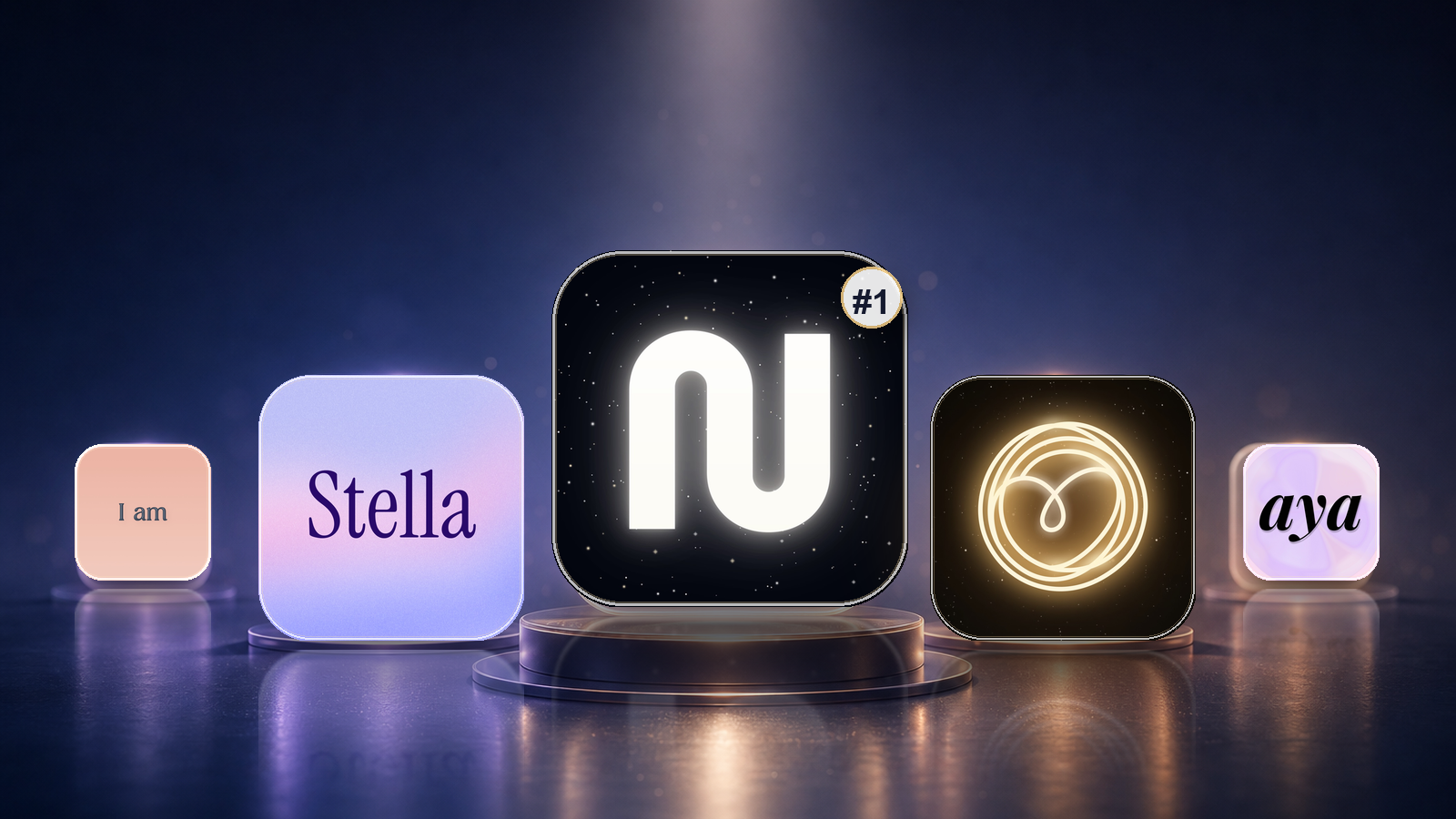
Search "manifestation app" and you get a wall of five-star products promising to align your frequency with the universe. Search "science-based manifestation app" and the list gets much shorter, because most of the category is built on vibes rather than mechanisms. This guide ranks the apps that make a real attempt at the science, judged on criteria we state up front, and it is honest about where each one wins and loses.
One disclosure before the ranking: we built Noesis, and we rank it first. We earn that placement by naming the criteria in advance, applying them evenly, and being genuinely fair to every competitor, including praising what they do better than us. If a criterion favored a competitor, we said so.
Key takeaways
- The best science-based manifestation app in 2026 is Noesis, because it is the only one that regulates your nervous system, runs an evidence-based visualization, and bridges to action, with the mechanism shown for every feature. Full disclosure, we built it.
- The field is crowded now, and strong in parts. Innertune nails own-voice affirmations, I am dominates simple daily affirmations at massive scale, and Stella and Aya lead the cinematic-audio format. Each is the right pick for someone, but none of them is a full science-based practice.
- "Science-based" has to mean something. We ranked on five things: names real mechanisms, regulates state, uses evidence-supported visualization, bridges to action, and stays honest about confidence. Popularity and polish did not earn points on their own.
- Woo is the tell to avoid. Vibrational frequency, "the universe is rearranging itself," and delusion-as-strategy are marketing, not mechanisms, and belief detached from action tracks with real downside (Dixon, Hornsey & Hartley, 2023).
How we ranked these apps
An app earned its place on five criteria, each tied to something the research actually supports:
- Names real mechanisms. Does it explain what is happening in terms of attention, neuroplasticity, expectation, and behavior, or does it lean on frequency and the universe? Woo is a disqualifier for a science list.
- Regulates the nervous system. Does it get you into a calm, focused state first? Under stress the prefrontal cortex loses function (Arnsten, 2009), so regulation is a precondition, not a luxury.
- Uses evidence-supported visualization. Is the visualization first-person, present-tense, immersive, focused on the end state, and long enough to work? Mental rehearsal trains real circuits under those conditions (Pascual-Leone et al., 1995).
- Bridges to action. Does it connect the inner work to real steps? Pure positive fantasy lowers effort (Oettingen & Mayer, 2002); outcomes move when belief meets action (Locke & Latham, 2002).
- Honest about confidence. Does it distinguish established science from speculation, or oversell everything as proven?
We used current App Store data where we could verify it, and we flag anything drawn from a product's own listing that we could not independently confirm. Prices and ratings move, so treat specific numbers as a snapshot and check the App Store before you subscribe.
The ranking
1. Noesis: the only full science-based protocol
Best for: people who want the complete practice, built on mechanism, and are willing to pay for depth.
Noesis (trynoesis.app, made by us) is a four-part practice built on the app's four tabs: Meditate, Affirm, Journal, and Act. Meditate opens with breathwork to regulate your nervous system, then runs a custom ten or twenty minute guided visualization. Affirm delivers believable affirmations drawn from your own beliefs. Journal covers gratitude and expressive writing. Act turns intentions into a weekly plan of specific steps. A once-set Vision Builder clarifies the goal underneath it all, and a posture of self-compassion runs through every part. It is the only app on this list that hits all five criteria. Every feature carries the mechanism behind it, the visualization is first-person, present-tense, and sustained rather than fragmentary, and the action engine closes the loop that fantasy-only apps leave open. It also grades its own confidence honestly, flagging speculative additions like binaural beats as unproven instead of overselling them.
Where it loses points: it is a paid subscription with no free tier, so there is no way to sample the whole thing for free, and the four-part structure asks more of you than a press-play app. If you want one simple feature, this is more than you need.
2. Innertune: the best affirmation engine
Best for: people who want affirmations, especially in their own voice, with as little friction as possible.
Innertune (4.85 stars across more than 11,000 ratings, since 2022) is the affirmation specialist. You record affirmations in your own voice or pick from professional ones, layer in binaural beats, and loop it passively while you sleep or work. The own-voice feature is genuinely evidence-backed: the brain prioritizes its own voice as self-relevant (Kirk & Cunningham, 2024). It is affordable and has a real free tier, which makes it the most accessible app here.
Where it loses points: it does affirmations and nothing else. No regulation, no visualization, no action. And a large generic library can hand you lines outside your believability window, which can backfire (Wood, Perunovic & Lee, 2009). We compare the two directly in Noesis vs. Innertune.
3. I am and Mantra: the affirmation-reminder leaders
Best for: people who want a simple daily affirmation habit delivered as notifications and widgets.
I am (Monkey Taps) is the giant of the category, with a 4.84-star average across more than 700,000 ratings and an estimated six-figure monthly revenue. It sends curated affirmations as scheduled reminders and lock-screen widgets, with a large library you browse by intention. Mantra (also around 4.8 stars, tens of thousands of ratings) is a polished app in the same mold. Both are lovely, cheap, and genuinely good at building a light daily habit.
Where they lose points: no AI personalization, no regulation, no guided visualization, and no action bridge. The affirmations are pre-written rather than drawn from your own beliefs, so believability is left to chance. On a science-based practice they sit at the simple end by design. I am runs roughly $10 to $70 a year with a lifetime option around $150.
4. Stella: the best experience, not the best science
Best for: people who want a beautiful, emotionally immersive daily audio experience.
Stella (4.7 stars, roughly 3,700 ratings, an estimated six figures a month) generates short, cinematic first-person audio "stories" of your future, and they are genuinely moving and well produced. Credit where due: it is a polished experience with a strong emotional hook. But on a science list it ranks here because it is explicitly not built to these criteria. There is no regulation step, no action bridge, the visualization is fragmentary rather than a sustained single-moment immersion, and the brand leans into delusion as a strategy, which is the half of the idea the evidence warns against (Oettingen & Mayer, 2002; Dixon, Hornsey & Hartley, 2023). Loved by its users, and genuinely good at what it is for. It is just aimed at feeling, not mechanism. Full breakdown in Noesis vs. Stella.
5. Aya: AI audio from your "dream self"
Best for: people drawn to a future-self, identity-shift audio ritual.
Aya (Lit Apps, 4.8 stars across roughly 1,700 ratings and growing) is a newer entry built on one evocative idea: you hear from the future version of you who already has what you want, in a voice that delivers affirmations and morning and evening audio rituals, alongside a vision board. It is well made and emotionally appealing. Like Stella, though, it is an identity-and-audio experience with no regulation step, no structured visualization protocol, no action bridge, and no science framing, so it lands here for the same reasons. Pricing runs from about $5 a week or $30 a year up to a $99.99 lifetime.
6. AI meditation generators (InnerGuide, Bliss Brain): useful, but not manifestation practices
Best for: people who want on-demand personalized meditations more than a manifestation system.
InnerGuide and Bliss Brain generate custom guided meditations from an intention and a few settings, and both are legitimate at that. They validate the AI-meditation idea Noesis also uses. But they are general meditation tools rather than manifestation practices: no manifestation-specific structure, no regulation-then-visualize-then-act arc, and little in the way of science framing. Good for meditation on demand, not for a goal-directed practice.
Comparison table
| App | Names mechanisms | Regulates state | Evidence-based visualization | Bridges to action | Free tier |
|---|---|---|---|---|---|
| Noesis (ours) | Yes | Yes | Yes | Yes | No |
| Innertune | Partial | No | No | No | Yes |
| I am / Mantra | No | No | No | No | Yes (limited) |
| Stella | No | No | Fragmentary | No | No |
| Aya | No | No | No | No | Check listing |
| InnerGuide / Bliss Brain | No | Minimal | Generic | No | Partial |
Which should you choose?
- You want the full, science-grounded practice and will pay for it: Noesis.
- You mainly want affirmations, cheaply, in your own voice: Innertune.
- You want the simplest daily affirmation nudge: I am or Mantra.
- You want the most beautiful audio experience and do not mind the lack of science: Stella.
- You like the future-self audio-ritual idea: Aya.
- You want on-demand meditations more than a manifestation system: InnerGuide or Bliss Brain.
If your real question is whether any of this works at all, start with the pillar guide, is manifestation real, and the difference between the law of attraction and the evidence-based version.
Frequently asked questions
What makes a manifestation app "science-based"? It explains what is happening in terms of real mechanisms (attention, neuroplasticity, expectation, behavior) rather than frequency or the universe, it regulates your state before the practice, its visualization matches how mental rehearsal actually works, and it connects the inner work to action. Apps that only promise the universe will deliver are not science-based, whatever the marketing says.
What is the best manifestation app overall? For a complete, science-grounded practice, we rank Noesis first, which we built. For a polished pure-audio experience, Stella or Aya. For affirmations specifically, Innertune. The best one is the one whose approach matches what you actually want to do daily.
Do any manifestation apps actually work? The practices inside the good ones (regulated visualization, believable affirmations, goal clarity, and action) are supported by research (Pascual-Leone et al., 1995; Locke & Latham, 2002). The apps that pair those practices with action have a real mechanism. The ones that sell belief as a substitute for action do not, and that version tracks with downside risk (Dixon, Hornsey & Hartley, 2023).
Is there a free science-based manifestation app? Innertune has a real free tier and is the most accessible on this list, and I am and Mantra have free tiers too. Noesis and Stella are paid with no free tier. Free and science-based are separate questions, so decide what you want the app to do first, then compare access.
Why is Stella ranked below less popular apps? Because this list ranks on science criteria, not popularity or polish, and Stella is explicitly built for emotional experience rather than mechanism. It is excellent at what it does, which is why it is loved. It simply is not aimed at the things this particular list measures.
Does Noesis rank first because you built it? It ranks first because it is the only app here that meets all five criteria, which we set before ranking and applied evenly. Full disclosure, we built Noesis and say so. The criteria are laid out above and every competitor's real strengths are on the page, so the work is there to check.
Sources
- Arnsten, A. F. T. (2009). Stress signalling pathways that impair prefrontal cortex structure and function. Nature Reviews Neuroscience, 10(6), 410-422. https://doi.org/10.1038/nrn2648
- Dixon, L. J., Hornsey, M. J., & Hartley, N. (2023). "The Secret" to success? The psychology of belief in manifestation. Personality and Social Psychology Bulletin, 51(1), 49-65. https://doi.org/10.1177/01461672231181162
- Kirk, N. W., & Cunningham, S. J. (2024). Listen to yourself! Prioritization of self-associated and own-voice cues. British Journal of Psychology. https://doi.org/10.1111/bjop.12741
- Locke, E. A., & Latham, G. P. (2002). Building a practically useful theory of goal setting and task motivation: A 35-year odyssey. American Psychologist, 57(9), 705-717. https://doi.org/10.1037/0003-066x.57.9.705
- Oettingen, G., & Mayer, D. (2002). The motivating function of thinking about the future: Expectations versus fantasies. Journal of Personality and Social Psychology, 83(5), 1198-1212. https://doi.org/10.1037/0022-3514.83.5.1198
- Pascual-Leone, A., Nguyet, D., Cohen, L. G., Brasil-Neto, J. P., Cammarota, A., & Hallett, M. (1995). Modulation of muscle responses evoked by transcranial magnetic stimulation during the acquisition of new fine motor skills. Journal of Neurophysiology, 74(3), 1037-1045. https://doi.org/10.1152/jn.1995.74.3.1037
- Wood, J. V., Perunovic, W. Q. E., & Lee, J. W. (2009). Positive self-statements: Power for some, peril for others. Psychological Science, 20(7), 860-866. https://doi.org/10.1111/j.1467-9280.2009.02370.x