
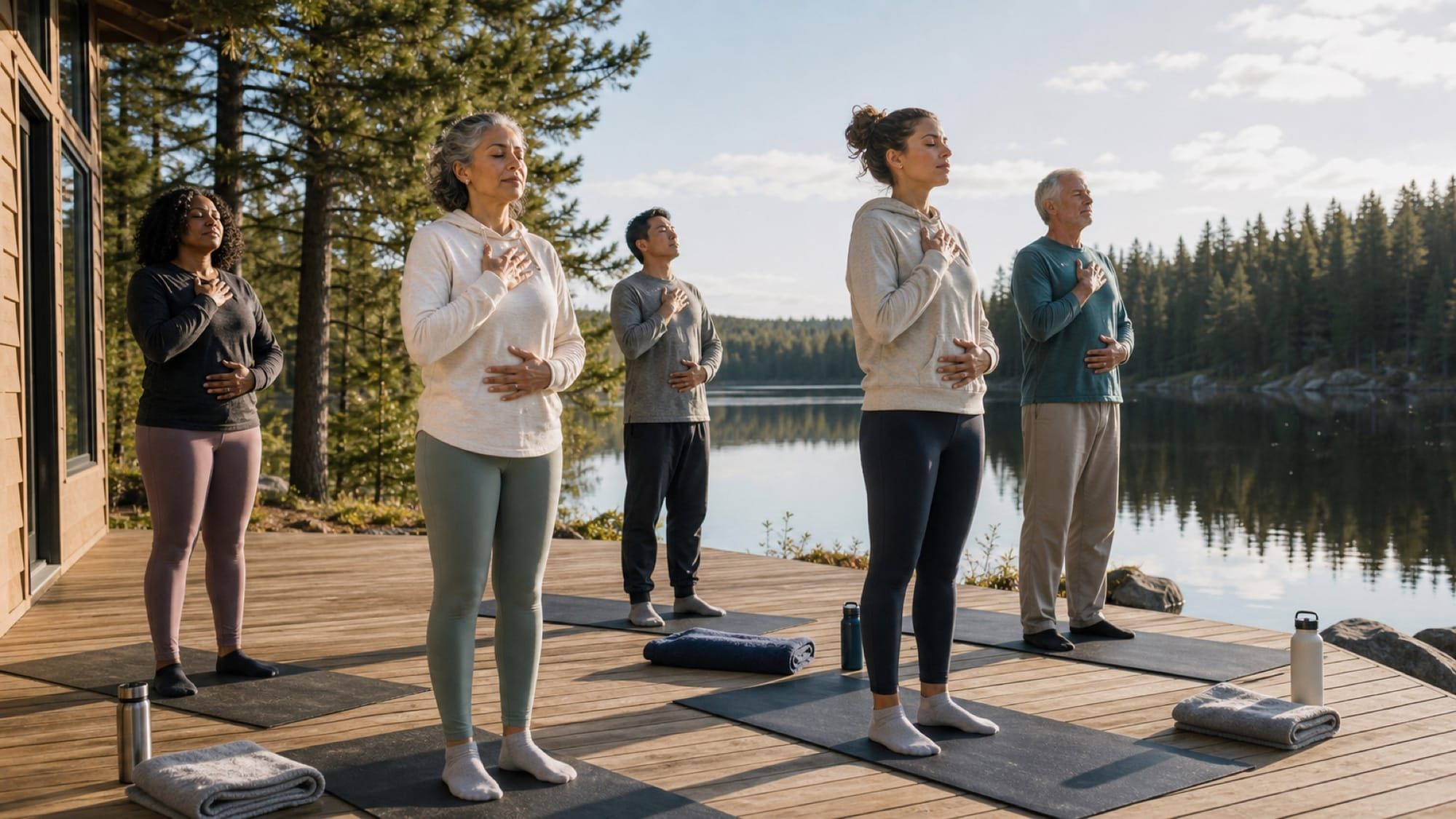
Slow, deliberate breathing is the fastest way to calm your nervous system, because the breath is the one branch of the autonomic system you can steer on purpose. Lengthening your exhale shifts you toward a calmer, more flexible state, indexed by vagal tone and heart rate variability. Regulate first, then practice. The vagus nerve is the lever, and your breath is the handle.
Key takeaways
- The vagus nerve is the main parasympathetic pathway, the “calm” branch of your autonomic nervous system, and breathing is the one branch you can reach voluntarily.
- A long, slow exhale tilts the balance toward that calm branch; higher heart rate variability (HRV) tracks better attention and emotional regulation (Thayer et al., 2009).
- Stress impairs the prefrontal cortex that visualization and planning rely on, so steadying the body comes first (Arnsten, 2009).
- Brief daily breathwork lowered respiratory rate and lifted mood more than mindfulness meditation in one controlled study, with the physiological sigh strongest (Yilmaz Balban et al., 2023).
- Three techniques cover most needs: the physiological sigh for fast relief, box breathing for steady calm, and 4-7-8 for winding down.
Almost everyone has been told to “just breathe,” usually at the least helpful moment, by someone who could not tell you why it works. So the advice lands as a platitude, you take one shallow breath, nothing shifts, and you file breathwork next to “think positive” in the drawer of things people say. That is a shame, because the mechanism underneath is real and unusually easy to operate. This is the practical layer of every other practice, the part where a clear physiological lever sits right under your hand.
Here is the through line. Your nervous system has a calm branch and an alert branch, and your breath is the one dial you can turn by hand. Slow it down, lengthen the exhale, and you nudge the whole system toward the calmer, more flexible state where clear thinking and steady emotion become available again. We will walk through what the vagus nerve actually does, what “vagal tone” means and why it matters, why regulating has to come before visualizing, and three concrete techniques with the science behind each. We will also be honest about the edges, because the field has its share of overreach.
What does breathwork do to your nervous system?
Breathwork shifts the balance of your autonomic nervous system toward calm. The autonomic nervous system runs your body’s automatic functions through two branches: the sympathetic branch mobilizes you for action, and the parasympathetic branch settles you down. Slow breathing, especially a long exhale, tips that balance toward the parasympathetic side.
The vagus nerve is the centerpiece here. It is the longest of the cranial nerves and the main highway of the parasympathetic branch, wandering from the brainstem down to the heart, lungs, and gut. When it is active, your heart rate eases, your body relaxes, and the felt sense is one of safety rather than threat. Most of your autonomic system runs without you, but breathing sits at an unusual crossroads: it happens on its own, yet you can take the wheel whenever you choose. That is what makes the breath the practical entry point. By changing how you breathe, you send a deliberate signal up the vagal pathway and change the state of the whole system.
The honest framing matters. We are pointing to vagal tone and heart rate variability as useful, measurable signals of autonomic regulation (Porges, 2001; Thayer et al., 2009). Some larger theories built on the vagus nerve remain debated, and a few popular claims about the heart’s “energy field” sit outside the evidence entirely. The narrow, well-supported claim is enough to work with: steer the breath, and you steer the state.
What is “vagal tone,” and why does it matter?
Vagal tone describes how strongly the vagus nerve applies its brake to your heart, and it is read indirectly through heart rate variability, the small beat-to-beat changes in your pulse. Higher HRV tends to track a more flexible, better-regulated nervous system. It is one of the cleaner windows we have into how well your body shifts between alert and calm.
Heart rate variability sounds like it should be bad. A steady metronome heartbeat seems healthier than a wobbly one. The opposite is true. A healthy heart speeds up slightly as you inhale and slows as you exhale, and a wider, more responsive range signals a nervous system that can move fluidly between gears. According to Thayer and colleagues’ 2009 paper in Annals of Behavioral Medicine, higher HRV is associated with better prefrontal function, stronger attentional control, and more effective emotion regulation. The vagus nerve, the heart, and the thinking brain are wired into one self-regulating loop, and HRV is the readout.
One caution keeps this grounded. HRV is an index, a correlate, rather than a switch you flip to a number. It reflects the state of your regulation, and you influence it indirectly by changing your breathing and your stress load over time. So the useful move is to work the lever you actually hold, the breath, and let the deeper measures follow. The point is the state, not the score.
Why regulate before you visualize or affirm?
Regulate first because stress quietly disables the brain region the rest of your practice depends on. Visualization, planning, and honest self-talk all run on the prefrontal cortex, the seat of focus and self-regulation. When your body is in a threat state, that machinery goes offline, so trying to rehearse a calm, confident future from a clenched nervous system works against itself.
The evidence here is blunt. According to Arnsten’s 2009 review in Nature Reviews Neuroscience, “even quite mild acute uncontrollable stress can cause a rapid and dramatic loss of prefrontal cognitive abilities.” This is the quiet flaw in most manifestation advice, which tells you to generate the feeling of already having what you want while your physiology is running a stress response that shuts down the very circuits you would use to get there. Picture someone trying to visualize their dream life while spiraling about their rent. The instruction and the body are pulling in opposite directions.
The fix is an order of operations. Steady the body, then engage the mind. This is the regulate-then-rehearse sequence Noesis is built around, the reason its first phase is breath and nervous-system settling. Most apps jump straight to the picturing. The science says the picturing only works once the body feels safe enough to host it. (For why a dysregulated state blocks the whole practice, see how stress blocks manifestation and the pillar on what the neuroscience actually says.)
The three techniques: physiological sigh, box breathing, and 4-7-8
Three slow-breathing patterns cover most situations, and all of them share one active ingredient: an exhale that is longer than the inhale, which loads the calming parasympathetic side. In a 2023 controlled study in Cell Reports Medicine, Yilmaz Balban and colleagues found that five minutes a day of structured breathwork lowered participants’ respiratory rate and improved their mood more than mindfulness meditation did, with the physiological sigh producing the largest gain in positive affect. Here is how to run each one.
1. The physiological sigh (fastest relief). This is the one for an acute spike of stress. - Inhale through your nose. - At the top, take a second short sip of air through your nose to fully inflate your lungs (the double inhale). - Let a long, slow breath out through your mouth until your lungs are empty. - Repeat one to five times.
The double inhale reopens collapsed air sacs and the extended exhale does the calming work. This is the pattern that came out strongest in Yilmaz Balban and colleagues’ 2023 study, and a version of it is something your body already does on its own when you sigh.
2. Box breathing (steady calm). This one is for sustained composure, the kind used to stay even under pressure. - Inhale through your nose for a count of 4. - Hold for 4. - Exhale through your mouth for 4. - Hold for 4. - Repeat for one to three minutes.
The equal, structured rhythm slows your breathing into the range where the autonomic system settles. It is portable, quiet, and easy to run before a hard conversation or a moment that asks for a clear head.
3. The 4-7-8 breath (winding down). This one is for the evening or for talking yourself down from a racing mind. - Inhale quietly through your nose for a count of 4. - Hold for 7. - Exhale fully through your mouth for 8. - Repeat for about four cycles.
The long 8-count exhale is the heart of it, far longer than the inhale, which leans hard on the parasympathetic branch. Keep the counts comfortable; the ratio matters more than the exact seconds.
How fast does breathwork work, and how often should you practice?
Breathwork can shift your state within a single session, and regular short practice is what makes the calm easier to reach over time. The acute effect is fast: a few rounds of a long-exhale pattern can lower arousal in minutes. The durable benefit comes from doing a little most days, the same way any pattern becomes the path of least resistance through repetition.
In Yilmaz Balban and colleagues’ 2023 study, participants practiced for roughly five minutes a day across a month, and the breathwork groups showed a greater reduction in resting respiratory rate than the meditation group, along with a lift in mood that built over the weeks. Short and frequent beat long and rare. A daily five minutes you actually do will outperform an occasional half-hour you mean to.
Two honest caveats keep expectations clean. First, that study was modest in size and measured daily practice over weeks, so treat it as promising and early. Notably, it found no significant difference in HRV between the specific breathing patterns, even as breathwork clearly moved respiratory rate and mood. Second, breathwork is a regulation tool, not a treatment for an anxiety disorder or depression. It steadies the nervous system so the rest of your practice can land, and that is a real and useful job. For anything clinical, it belongs alongside care, not instead of it.
Frequently asked questions
How does breathing calm you down? Slow breathing, especially an exhale longer than the inhale, shifts your autonomic balance toward the parasympathetic (calming) branch through the vagus nerve. Higher heart rate variability tracks that more regulated state and correlates with better attention and emotion regulation (Thayer et al., 2009).
What is the fastest breathing technique to calm down? The physiological sigh: a double inhale through the nose followed by a long, slow exhale through the mouth, repeated a few times. In Yilmaz Balban and colleagues’ 2023 study in Cell Reports Medicine, brief daily cyclic sighing improved mood and lowered respiratory rate more than mindfulness meditation.
Does box breathing actually work? Yes, for shifting your state. It is a structured slow-breathing pattern (inhale 4, hold 4, exhale 4, hold 4), and the evidence that controlled slow breathing lowers physiological arousal is solid, even though one study found no HRV difference between specific patterns (Yilmaz Balban et al., 2023).
Is the vagus nerve real, or just a wellness buzzword? Real. It is the main parasympathetic nerve, running from the brainstem to the heart, lungs, and gut. The well-supported claim is narrow: vagal tone, read through HRV, indexes autonomic and emotional regulation (Thayer et al., 2009; Porges, 2001). Some broader theories built on it remain debated.
Why should I breathe before trying to manifest? Because stress impairs the prefrontal cortex that visualization and planning depend on (Arnsten, 2009). Regulating your nervous system first puts that machinery back online, so the rest of the practice has something to work with.
How long until breathwork changes anything? A single session can lower arousal in minutes. Lasting change in how easily you reach calm comes from short, regular practice, around five minutes most days in the research (Yilmaz Balban et al., 2023).
Related reading: Is manifestation real? What the neuroscience actually says · How stress blocks manifestation · How to actually let go and detach · Manifesting while anxious or depressed
If you want a structured place to practice the regulate-then-rehearse sequence, starting with the breath before anything else, that is what Noesis is built to do.
Sources
- Arnsten, A. F. T. (2009). Stress signalling pathways that impair prefrontal cortex structure and function. Nature Reviews Neuroscience, 10(6), 410–422. https://doi.org/10.1038/nrn2648
- Porges, S. W. (2001). The polyvagal theory: Phylogenetic substrates of a social nervous system. International Journal of Psychophysiology, 42(2), 123–146. https://doi.org/10.1016/s0167-8760(01)00162-3
- Thayer, J. F., Hansen, A. L., Saus-Rose, E., & Johnsen, B. H. (2009). Heart rate variability, prefrontal neural function, and cognitive performance: The neurovisceral integration perspective on self-regulation, adaptation, and health. Annals of Behavioral Medicine, 37(2), 141–153. https://doi.org/10.1007/s12160-009-9101-z
- Yilmaz Balban, M., Neri, E., Kogon, M. M., Weed, L., Nouriani, B., Jo, B., Holl, G., Zeitzer, J. M., Spiegel, D., & Huberman, A. D. (2023). Brief structured respiration practices enhance mood and reduce physiological arousal. Cell Reports Medicine, 4(1), 100895. https://doi.org/10.1016/j.xcrm.2022.100895