
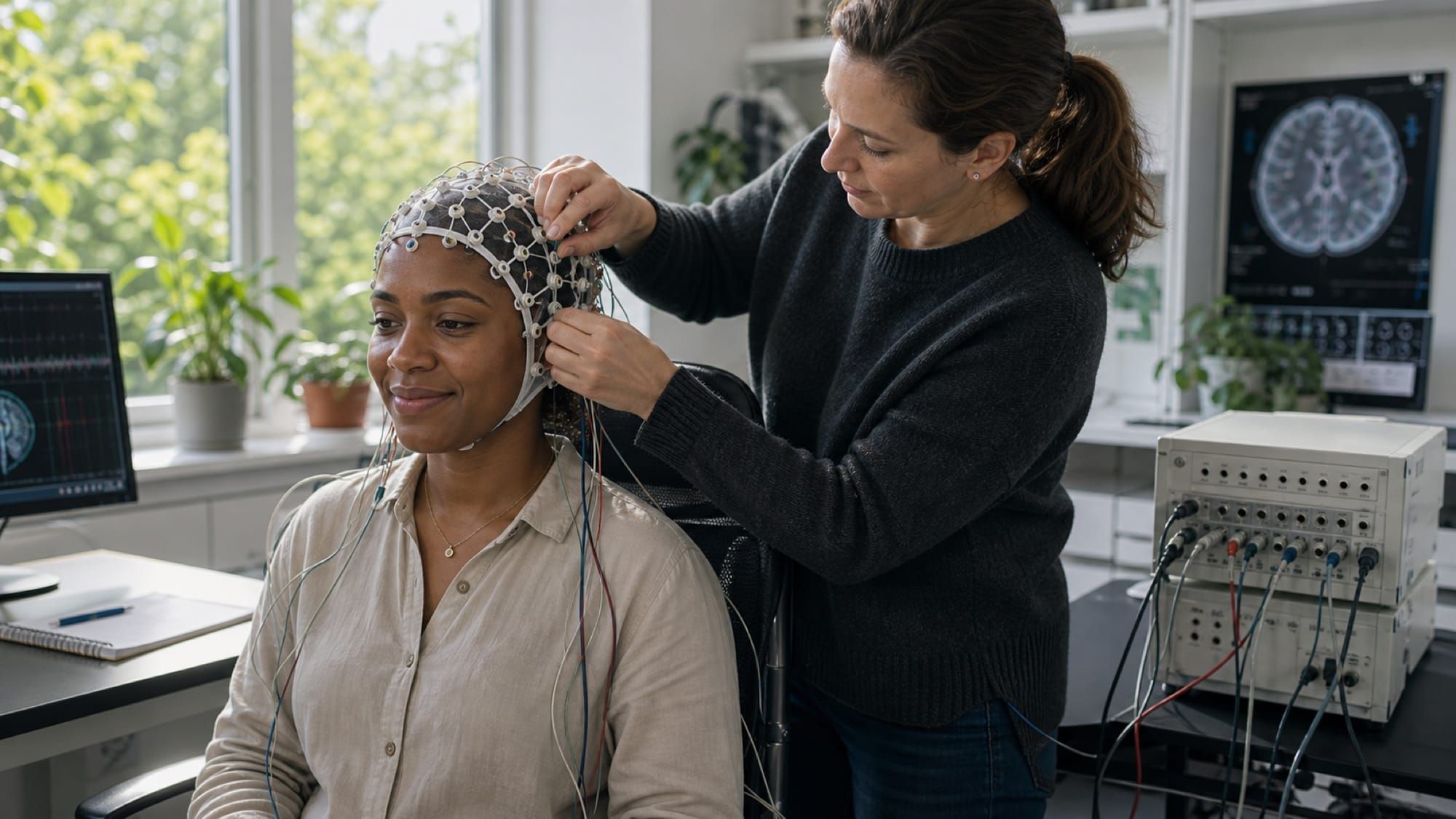
Yes, meditation changes the brain, and the honest size of that change is moderate, not magical. Experienced meditators show thicker cortex in attention and body-awareness regions (Lazar et al., 2005), and eight weeks of training raised grey-matter density in the hippocampus (Hölzel et al., 2011). The symptom benefits are real but small to moderate (Goyal et al., 2014).
Key takeaways
- Meditation does produce measurable brain changes, but they are gradual and moderate, not the overnight rewiring the headlines promise.
- Experienced meditators have thicker cortex in attention and interoception regions, though that study is cross-sectional, so it shows an association, not proof that meditation caused it (Lazar et al., 2005).
- Eight weeks of mindfulness training raised grey-matter density in the hippocampus in a small randomized study (Hölzel et al., 2011).
- For anxiety, depression, and pain, the benefits are small to moderate, around 0.3 on a standard effect-size scale, with no evidence meditation beats medication or therapy (Goyal et al., 2014).
- The “shrinks your amygdala” claim traces to one small study, and even there it was a correlation with reduced stress (Hölzel et al., 2010). Real signal, oversized headline.
You have probably seen the bigger claims: meditation rewires your brain, grows new grey matter, shrinks the fear center, beats antidepressants. You have also probably seen the eye-roll in response, the suggestion that it is all wellness marketing and breathing exercises dressed up in neuroscience. Both versions miss the more useful truth, which sits in between and is genuinely worth knowing.
Meditation changes the brain, the evidence for that is solid, and the changes are real enough to take seriously. The size of the effect is moderate. The timeline runs to weeks of practice, not a single session, and the most dramatic-sounding claims rest on the thinnest evidence. This piece walks through what the research actually confirms, names the effect sizes out loud, and separates the confirmed from the overhyped, so you can decide whether the practice earns a place in your day. (For how meditation fits among the other mechanisms people lump under manifestation, see our pillar on what the neuroscience actually says.)
Does meditation actually change your brain?
Yes. Meditation is associated with measurable differences in brain structure, and a short course of training has been shown to change grey matter in weeks. Two things keep that from being a bigger claim than it is. The effects are moderate, and several of the best-known findings are correlational or built on small samples. The signal is genuine, and it is easy to overstate.
The word “change” is where most of the confusion starts. People hear it and picture something fast and total, a brain reorganized over a retreat weekend. What the research shows is steadier and more specific: with regular practice, certain regions tied to attention, body awareness, and memory show structural differences that track with how much you practice. That fits everything we know about neuroplasticity, the brain’s lifelong capacity to reshape itself with repeated experience. Meditation is, at bottom, repeated attention training, and the brain responds to it the way it responds to other sustained skills.
So the headline is true in its plain form and false in its inflated form. The plain form: a consistent practice leaves a physical trace on the organ that does the practicing. The inflated form: that trace is huge, instant, and life-rearranging. Hold the first, drop the second, and you are reading the science correctly.
What brain changes are actually confirmed?
Two findings anchor the structural story. According to Lazar and colleagues’ 2005 study in NeuroReport, long-term meditators had thicker cortex in regions tied to attention and interoception, the sense of your own internal state. And in Hölzel and colleagues’ 2011 study in Psychiatry Research, eight weeks of training raised grey-matter density in the hippocampus, a region central to learning and memory.
Lazar’s team scanned 20 experienced meditators against matched controls and found greater cortical thickness in the prefrontal cortex and the right anterior insula, with the prefrontal difference largest in older participants, a hint that practice might offset some age-related thinning. The limit is built into the design. This study is cross-sectional: it compares people who already meditate to people who do not, so it shows that meditation is associated with thicker cortex, without establishing that meditation caused it. People drawn to years of practice may differ to begin with.
The Hölzel study closes part of that gap. It was a small randomized design, 16 people through an eight-week mindfulness-based stress reduction course against 17 on a wait-list, with brain scans before and after. The trainees showed increased grey-matter density in the left hippocampus, plus changes in the posterior cingulate, the temporo-parietal junction, and the cerebellum. Because the training came first and the change followed, this points toward meditation doing the reshaping. The catch is the sample: a few dozen people is a small base, and small studies need replication before anyone calls a finding settled. So the fair verdict is confirmed in outline, modest in scale, and still accumulating evidence.
Does meditation shrink the amygdala?
This is the popular claim, and it deserves a precise answer. One small study found that an eight-week mindfulness course was followed by reduced grey-matter density in the amygdala, the brain’s threat-processing hub, and that the reduction tracked with how much people’s stress dropped (Hölzel et al., 2010). A real finding from a single study, and one that gets overstated constantly.
In that study, 26 stressed but healthy adults completed a mindfulness-based stress reduction program with scans before and after. The people whose perceived stress fell the most showed the largest decreases in grey-matter density in the right basolateral amygdala. The authors framed it carefully, as a correlation between a psychological change and a structural one, not as proof that meditation reliably shrinks a brain region in everyone who tries it.
Two things are worth keeping straight. First, the attribution: the amygdala result is from the 2010 paper, while the hippocampus growth is from the separate 2011 paper, and they get blurred together constantly online. Second, the strength of the claim. “Meditation shrinks your amygdala” turns a single small correlational finding into a guaranteed mechanism, which the evidence does not yet support. Treat it as promising rather than proven, and you are being faithful to what the researchers actually reported.
How well does meditation work for anxiety, depression, and pain?
The benefits are real and small to moderate. The most rigorous summary, Goyal and colleagues’ 2014 meta-analysis in JAMA Internal Medicine, pooled 47 trials and 3,515 participants and found that mindfulness-meditation programs produced modest reductions in anxiety, depression, and pain, with effect sizes around 0.3. Helpful, in other words, but not miraculous.
The numbers are worth stating plainly, because they are the antidote to the hype. The effect sizes were about 0.38 for anxiety and 0.30 for depression at eight weeks, easing to roughly 0.22 and 0.23 by three to six months, and about 0.33 for pain. An effect size near 0.3 is a small-to-moderate change, the kind that helps a meaningful number of people without transforming everyone. The authors’ own phrasing was that meditation programs “can result in small to moderate reductions of multiple negative dimensions of psychological stress.”
There is one more finding that matters as much as the effect sizes. The review found no evidence that meditation worked better than active treatments such as medication, exercise, or therapy. It is a genuinely useful tool, on roughly the same footing as other good options, not a replacement that outperforms them. That single sentence rules out a lot of the overselling in one stroke. (Worth noting, too, that mindfulness and guided visualization are not the same practice and do different jobs in the brain, which we unpack in guided visualization vs. mindfulness.)
What is overhyped about “meditation rewires your brain”?
The plasticity is real. What the marketing inflates is the speed and the scale. The overhyped version compresses weeks of gradual change into an instant transformation, treats a couple of small studies as settled mechanism, and implies meditation outperforms established treatments. The research supports none of those leaps.
Take “rewires your brain.” The structural findings are gradual and measured over weeks, the symptom effects are moderate, and the amygdala claim rests on a single correlational study (Hölzel et al., 2010). Calling that “rewiring” is technically defensible and emotionally misleading, because it implies a dramatic, fast overhaul that the data simply do not show. The same goes for “cures anxiety” or “beats medication”: the strongest evidence to date found meditation no better than active treatments (Goyal et al., 2014).
None of this is a reason to dismiss the practice, and that is the part the cynics get wrong in the other direction. The accurate reading lands between the wellness brochure and the eye-roll. Meditation changes the brain in real, replicable ways, the changes are smaller and slower than advertised, and a moderate, reliable benefit from a free practice is still a good deal. Both the believer who oversells and the skeptic who dismisses are reading past the evidence.
So is meditation worth doing?
For most people, yes. A small-to-moderate benefit for anxiety, depression, and pain, from a low-cost, low-risk practice that also leaves measurable traces on attention and memory regions, is a genuinely good trade. The key is expecting the real thing, steady moderate gain over weeks, instead of the advertised thing, fast transformation.
Set the dial correctly and meditation becomes easy to recommend. Plan for weeks of consistent practice, not a breakthrough by Friday. Expect calmer reactivity and steadier focus more than a personality overhaul. And treat it as one tool among several, useful alongside therapy, movement, sleep, and the rest of what supports a nervous system, not a single lever that replaces them. If part of what you want is faster, in-the-moment regulation, simple breathwork shifts your state within a single session, which is a different and complementary job (see breathwork and the vagus nerve).
And there is room for honest wonder at the edges. We are still mapping how long-term practice shapes the brain over years, who benefits most, and why a quiet act of sustained attention should change tissue at all. The confirmed core is solid and moderate. The frontier is open and interesting. Holding both is the most accurate, and the most exciting, way to read the science.
If you want a structured way to fold meditation into a daily, research-grounded practice, that is the kind of thing Noesis is built to support.
Frequently asked questions
Does meditation actually change your brain? Yes, structurally and functionally, but moderately. Experienced meditators show thicker cortex in attention and interoception regions (Lazar et al., 2005), and eight weeks of training raised hippocampal grey-matter density in a small randomized study (Hölzel et al., 2011). The changes are real and gradual, accumulating over weeks rather than in a single sitting.
Does meditation shrink the amygdala? One small study found reduced amygdala grey-matter density after an eight-week mindfulness course, and the reduction correlated with how much people’s perceived stress dropped (Hölzel et al., 2010). It is a real but single, correlational finding, so “meditation shrinks your amygdala” is better treated as promising than as settled fact.
How long until meditation changes your brain? Structural changes have been measured after about eight weeks of regular practice in small studies (Hölzel et al., 2011), and symptom benefits in trials typically emerge over roughly eight weeks as well (Goyal et al., 2014). Plan for weeks of consistent practice, not days.
How effective is meditation for anxiety and depression? A JAMA Internal Medicine meta-analysis of 47 trials and 3,515 participants found small-to-moderate reductions in anxiety (about 0.38), depression (about 0.30), and pain (about 0.33), with no evidence that meditation outperformed active treatments such as medication, exercise, or therapy (Goyal et al., 2014).
Is “meditation rewires your brain” overhyped? Partly. The plasticity is genuine, but the popular version oversells the speed and scale. Structural change is gradual, the symptom effects are moderate, and meditation has not been shown to beat established treatments (Goyal et al., 2014). The accurate version is real benefit, right-sized.
Sources
- Goyal, M., Singh, S., Sibinga, E. M. S., Gould, N. F., Rowland-Seymour, A., Sharma, R., Berger, Z., et al. (2014). Meditation programs for psychological stress and well-being: A systematic review and meta-analysis. JAMA Internal Medicine, 174(3), 357–368. https://doi.org/10.1001/jamainternmed.2013.13018
- Hölzel, B. K., Carmody, J., Evans, K. C., Hoge, E. A., Dusek, J. A., Morgan, L., Pitman, R. K., & Lazar, S. W. (2010). Stress reduction correlates with structural changes in the amygdala. Social Cognitive and Affective Neuroscience, 5(1), 11–17. https://doi.org/10.1093/scan/nsp034
- Hölzel, B. K., Carmody, J., Vangel, M., Congleton, C., Yerramsetti, S. M., Gard, T., & Lazar, S. W. (2011). Mindfulness practice leads to increases in regional brain gray matter density. Psychiatry Research: Neuroimaging, 191(1), 36–43. https://doi.org/10.1016/j.pscychresns.2010.08.006
- Lazar, S. W., Kerr, C. E., Wasserman, R. H., Gray, J. R., Greve, D. N., Treadway, M. T., McGarvey, M., et al. (2005). Meditation experience is associated with increased cortical thickness. NeuroReport, 16(17), 1893–1897. https://doi.org/10.1097/01.wnr.0000186598.66243.19